
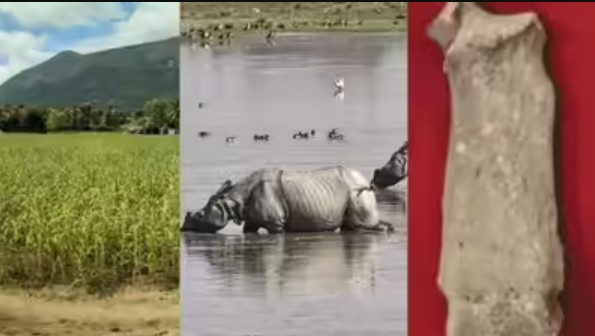
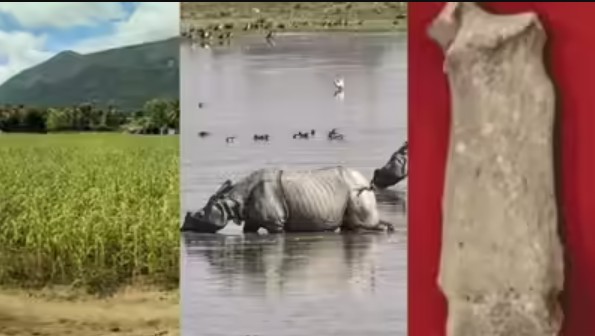
In a significant prehistoric discovery, archaeologists working near Coimbatore in Tamil Nadu have unearthed rhinoceros bone fragments dating back approximately 3,500 years. Found in the foothills of the Western Ghats, this discovery challenges long-standing assumptions about the ancient distribution of large mammals in the Indian subcontinent.
Until now, rhinoceroses—particularly the one-horned species—were believed to have been restricted to the riverine plains and wetlands of northeastern India, such as Assam and parts of Bengal. This new evidence suggests that these massive herbivores once roamed much farther south, deep into peninsular India.
A Rare Glimpse into Prehistoric South India
The bone fragments were recovered from a prehistoric habitation layer dated to the late Bronze Age. Preliminary zooarchaeological analysis indicates that the remains belonged to an adult rhinoceros, implying the existence of stable ecosystems capable of sustaining megafauna.
Researchers believe that the Western Ghats foothills during this period featured a diverse ecological landscape—combining grasslands, forest cover, and perennial water sources. Such conditions would have been suitable not only for rhinoceroses but also for other large mammals now absent from southern India.
Redefining the Ancient Range of Rhinoceroses in India
The discovery significantly extends the known historical range of rhinoceroses by several hundred kilometers. Previously, fossil and historical evidence placed these animals almost exclusively in eastern and northeastern India.
This find raises critical questions:
- Did climatic conditions during the Holocene support wider rhino habitats?
- Were grassland corridors more extensive across southern India?
- Did early human communities interact with or hunt these animals?
Ongoing research aims to address these questions through further excavation, radiocarbon dating, and comparative faunal studies.
Implications for Climate and Environmental History
Beyond zoology, the discovery has broader implications for understanding ancient climate patterns and environmental change in South India. The presence of large water-dependent mammals suggests wetter climatic conditions during the mid-to-late Holocene, followed by gradual environmental shifts that may have contributed to their regional extinction.
Such findings help archaeologists reconstruct how ecosystems evolved and how human and animal populations adapted—or failed to adapt—to long-term environmental change.
Why This Discovery Is Archaeologically Important
- Extends prehistoric faunal boundaries in peninsular India
- Challenges existing models of Holocene ecology in South India
- Highlights the Western Ghats as a key region for prehistoric research
- Strengthens the need for systematic faunal studies in southern archaeological sites
As further studies continue, this discovery underscores how each new archaeological find has the potential to reshape our understanding of India’s deep past.