
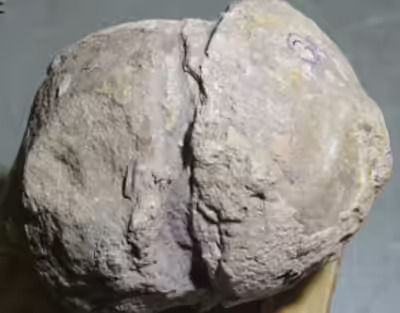
Did you know that villagers in Madhya Pradesh were unknowingly worshipping 70-million-year-old dinosaur eggs as sacred kuldevta stones? Recent research by the Birbal Sahni Institute of Palaeosciences (BSIP) has confirmed that these smooth stones in Padlya village, Dhar district, are actually fossilised titanosaur eggs from the Late Cretaceous period.
Discovery in the Narmada Valley
The Narmada Valley’s Lameta Formation has emerged as one of the largest dinosaur hatcheries in the world. In 2023, scientists documented 92 nests and 256 eggs, revealing the scale at which titanosaurs once bred in this region.
Unique Egg Structures
Among the finds are rare features like:
- Egg-within-egg formations
- Multi-shelled eggs
These give vital clues to dinosaur reproductive biology and evolutionary links between reptiles and modern birds.
Geological Background
Around 70 million years ago, after the Seychelles separated from the Indian Plate, the Tethys Sea extended into central India. Over time, sediments preserved these eggs, later mistaken by locals as divine stones.
Cultural Significance
For generations, villagers revered these fossils as “Kakar Bhairav,” blending ancient life with living traditions. This rare overlap of palaeontology and folk belief makes the Narmada Valley unique in the history of science.