
A Rare Prehistoric Ritual Landscape from the Deccan
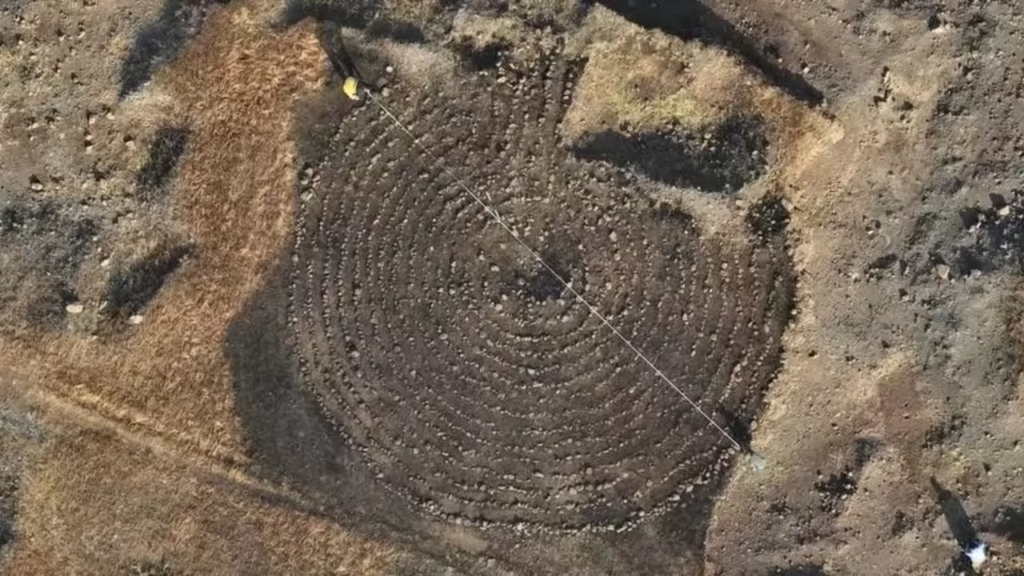
A remarkable archaeological discovery in Solapur has brought national attention to what is believed to be India’s largest circular stone labyrinth. Unlike familiar megalithic burials, cairn circles, or habitation sites, this structure represents a distinct and rare category of prehistoric ritual architecture in the Indian subcontinent.
The discovery adds a new dimension to our understanding of prehistoric communities in the Deccan plateau and their relationship with space, movement, and symbolism.
Understanding the Solapur Circular Labyrinth
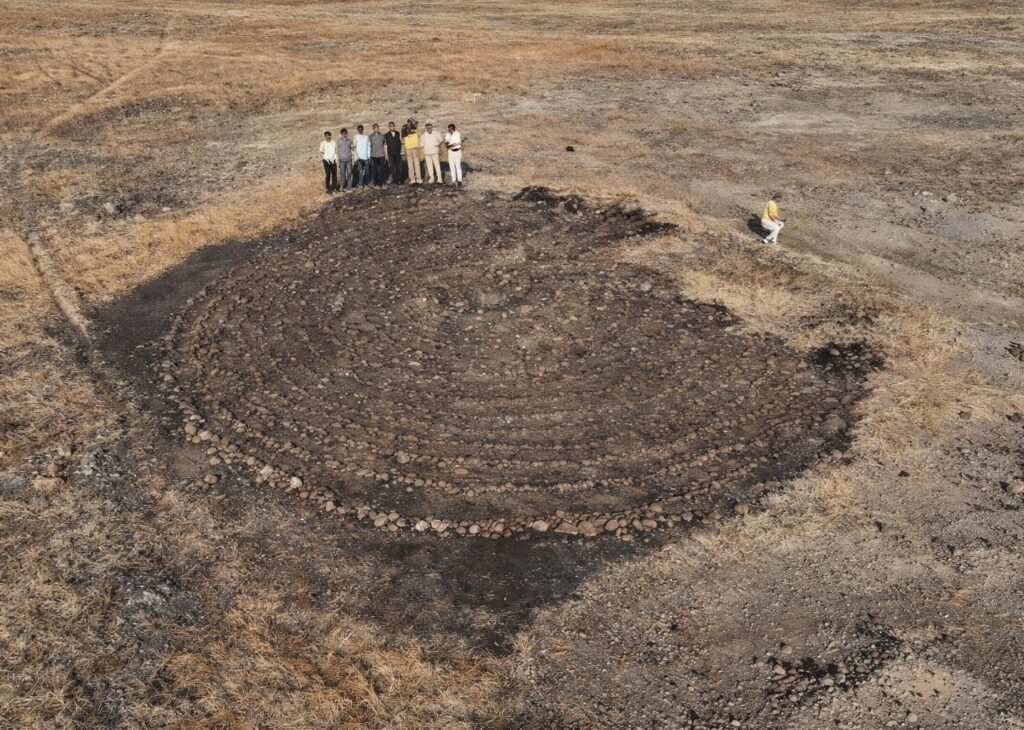
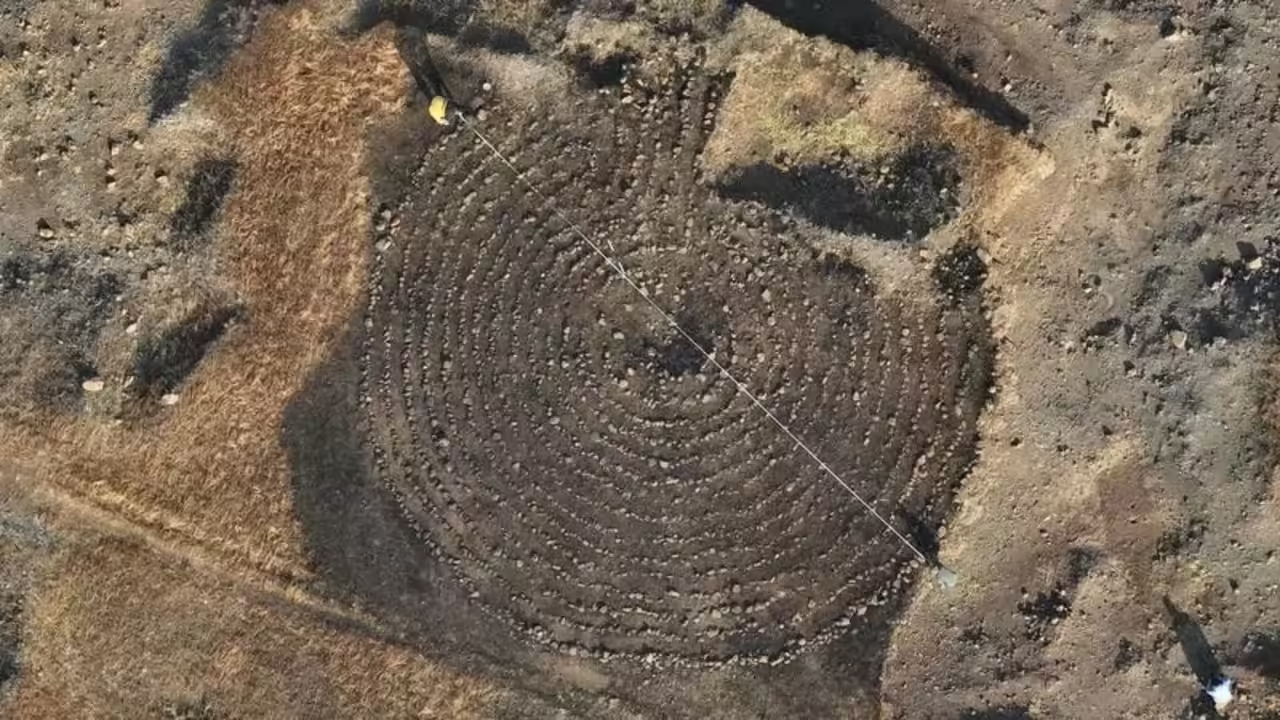
The structure consists of carefully arranged concentric stone pathways, forming a large circular plan. The stones are not randomly placed; instead, they show intentional design and planning, indicating collective effort and shared cultural meaning.
Key characteristics:
- Large circular layout with multiple concentric paths
- Clearly defined movement-oriented design
- No evidence of domestic activity such as hearths or tools
- No burial markers, human remains, or grave goods
These features suggest that the site was neither residential nor funerary, pointing instead toward a ritual or ceremonial purpose.
How Is This Different from Typical Megalithic Sites?
Most prehistoric sites in Maharashtra are associated with:
- Burial practices
- Memorial stones
- Settlement remains
The Solapur labyrinth stands apart because it focuses on movement through space rather than a fixed focal point. Such spatial planning implies ritual walking, procession, or symbolic journeys, practices known from prehistoric contexts across the world but rarely documented in India.
Circular Labyrinths in World Archaeology
Circular labyrinths are known from several ancient cultures, where they are often interpreted as:
- Ritual pathways
- Initiation routes
- Seasonal or calendrical markers
- Symbolic representations of order and time
In archaeological terms, labyrinths are not puzzles but structured paths designed to be experienced physically. The Solapur discovery suggests that similar concepts may have existed in prehistoric India, expanding the cultural vocabulary of early Deccan societies.
Archaeological Interpretation of the Solapur Labyrinth
While detailed excavation and dating are still awaited, preliminary observations allow several interpretations:
- Ritual procession space: Designed for collective or individual movement during ceremonies
- Community gathering landmark: A shared symbolic structure strengthening social identity
- Cosmological representation: Circular geometry often reflects ideas of cycles, continuity, and time
- Non-verbal knowledge system: Meaning conveyed through movement rather than written or sculptural symbols
Importantly, the absence of inscriptions or imagery indicates that architecture itself was the message.
Why Solapur? The Regional Context
Solapur lies within the Deccan plateau, a region rich in prehistoric and protohistoric remains. The landscape offers:
- Stable geological conditions
- Open horizons
- Long-term human occupation
Such environments were ideal for creating large communal structures meant to endure across generations. The location strengthens the argument that the labyrinth was a deliberate cultural landmark, not an isolated or accidental formation.
Prehistory Beyond Tools and Burials
Indian prehistory is often understood through tools, pottery, and graves. The Solapur labyrinth challenges this narrow view by highlighting:
- Symbolic landscapes
- Ritual use of open space
- Social practices not tied to death or survival
This discovery encourages archaeologists to look beyond artefacts and consider movement, memory, and spatial experience as critical components of prehistoric life.
Why This Discovery Matters
The Solapur circular labyrinth is important because it:
- Introduces a rare architectural form into Indian archaeology
- Expands the understanding of prehistoric ritual practices
- Highlights Maharashtra as a key region for future research
- Encourages interdisciplinary study involving landscape archaeology and spatial analysis
As systematic documentation, excavation, and dating continue, this site may significantly reshape interpretations of prehistoric social and ritual behavior in India.
Conclusion
The circular labyrinth of Solapur is not merely a stone structure—it is a prehistoric cultural statement carved into the landscape. Its scale, planning, and form suggest a society capable of abstract thought, collective effort, and symbolic expression.
For The Indian Archaeology, this discovery stands as a reminder that India’s prehistoric past still holds unexplored stories written not in texts, but in stone and space.
📷 Image Credits & Disclaimer
Image Credits:
All images used in this article are for educational and representational purposes only. Images are sourced from Google Images, Wikimedia Commons, public-domain archives, and open-access archaeological resources.
© Rights belong to the respective photographers and copyright holders.
Disclaimer:
The Indian Archaeology does not claim ownership of any images unless explicitly stated. If you are the rightful owner of any image and wish for credit or removal, please contact us.