
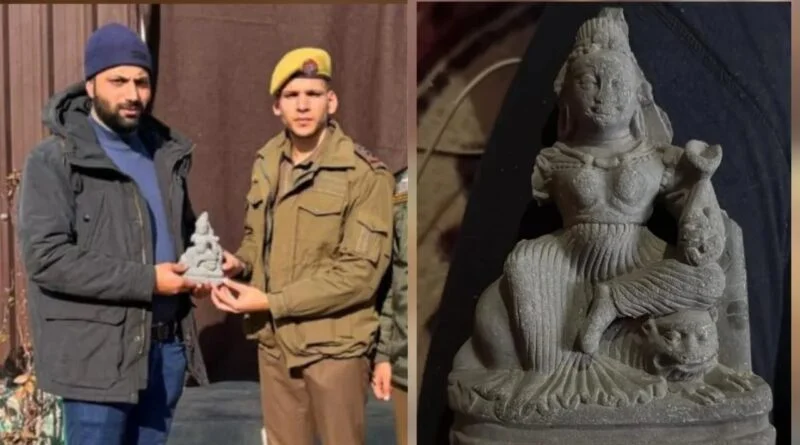
The recent recovery of an ancient stone idol of Goddess Durga from the Jhelum River has drawn attention to Kashmir’s deep and often overlooked Hindu religious and artistic traditions. This significant archaeological find adds a new layer to our understanding of Kashmir as a vibrant cultural crossroads where Shaivism, Shaktism, and Buddhism once flourished together.
Discovery from the Jhelum River
The idol was retrieved during a local recovery operation from the riverbed of the Jhelum. Preliminary observations indicate that the sculpture had remained submerged for a long period, which may have contributed to its preservation.
Such discoveries from river contexts are not uncommon in the Indian subcontinent, where rivers have long served as:
- Sacred ritual spaces
- Sites for ceremonial immersion
- Natural repositories protecting icons during invasions or temple destruction
Description of the Durga Idol
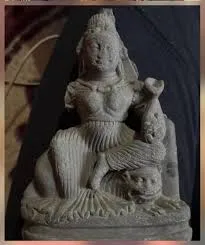
The sculpture portrays Goddess Durga, likely in her Mahishasuramardini form—the divine slayer of the buffalo demon Mahishasura.
Notable Features:
- Carved from stone, consistent with Kashmir Valley sculptural traditions
- Balanced proportions and calm facial expression
- Strong iconographic symbolism associated with Shakta worship
- Weathering patterns suggesting prolonged submersion
Based on stylistic elements, archaeologists tentatively date the idol to the early medieval period (c. 7th–10th century CE).
Kashmir’s Shakta Tradition: A Forgotten Chapter
While Kashmir is widely known for its Shaiva philosophy (Kashmir Shaivism) and Buddhist heritage, Shaktism also played a crucial role in the region’s spiritual landscape.
Historical and archaeological evidence suggests:
- Worship of the Divine Mother alongside Shiva
- Presence of multiple temples dedicated to feminine deities
- Integration of Shakta rituals within broader Shaiva traditions
The recovered Durga idol strengthens the argument that Goddess worship was well-established in Kashmir long before the medieval period.
Archaeological Significance
This discovery is important for several reasons:
- Confirms early medieval Hindu iconography in Kashmir
- Provides material evidence for Shakta practices
- Helps identify possible lost temple locations along riverbanks
- Contributes to the study of regional art schools
Riverine finds like this often act as silent witnesses to periods of political instability, religious transformation, or deliberate safeguarding of sacred icons.
Conservation and Future Study
The idol will likely undergo:
- Detailed iconographic and stylistic analysis
- Scientific conservation to prevent further deterioration
- Documentation by archaeology departments
- Potential display in a regional museum
Further research may help establish:
- Exact dating
- Workshop or sculptural lineage
- Original temple context
Conclusion
he recovery of the ancient Durga idol from the Jhelum River is more than a news event—it is a reminder of Kashmir’s pluralistic and layered past. As archaeology continues to uncover such hidden narratives, each discovery brings us closer to understanding how deeply interconnected faith, art, and geography were in ancient India.
For platforms like The Indian Archaeology, such finds are vital in reclaiming and documenting India’s shared cultural heritage.