
At The Indian Archaeology, we explore how ancient discoveries across the world mirror the same human curiosity that shaped India’s early astronomical traditions
🌄 A Discovery That Rewrites Time Itself
Somewhere in the misty landscapes of Aberdeenshire, Scotland, archaeologists uncovered what may be the world’s oldest calendar — built not by kings or priests, but by hunter-gatherers nearly 12,000 years ago.
This remarkable site, known as Warren Field, features 12 carefully dug pits, aligned with the movement of the moon and the midwinter sunrise. Each pit likely represented a lunar month, forming a yearly cycle that helped our ancestors track time, seasons, and life itself.
🌙 Humanity’s First Attempt to Measure Time
Long before clocks, empires, or written history, early humans noticed the rhythm of the skies.
The waxing and waning of the moon, the return of winter and summer, and the patterns of animal migration were nature’s signals for survival.
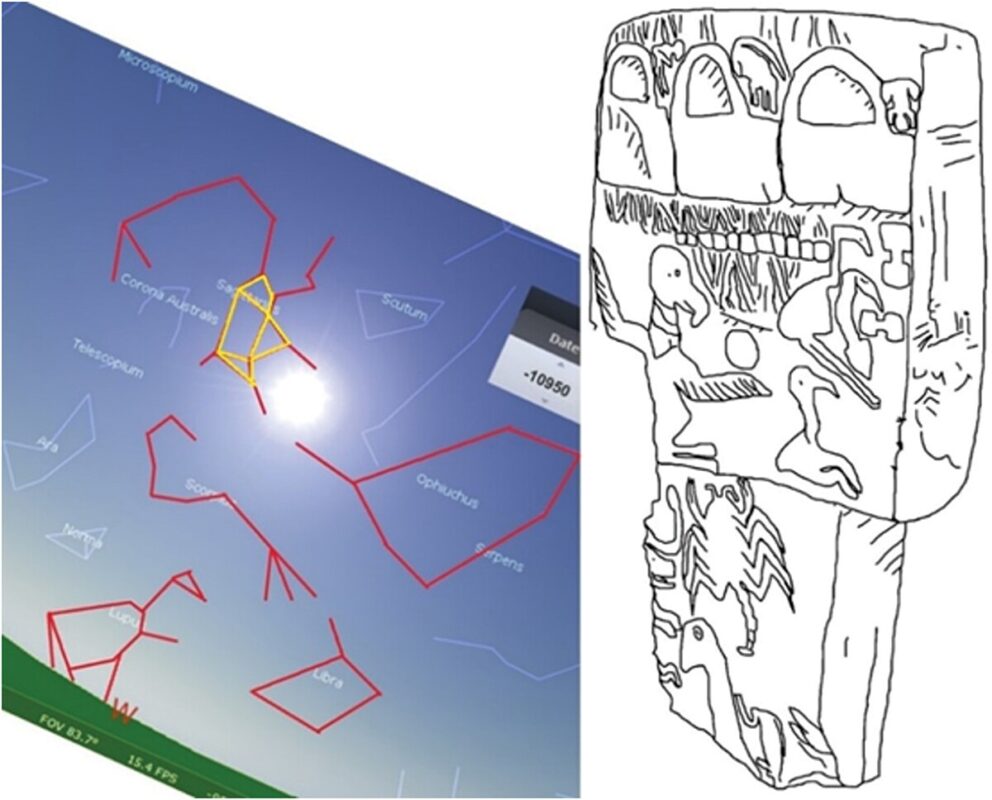
By aligning these pits to lunar phases and solstices, the people of Warren Field created a cosmic calendar — a tool to harmonize their lives with celestial cycles.
It wasn’t just about counting days — it was about understanding existence.
🔭 How the Calendar Worked
Researchers from the University of Birmingham and the National Trust for Scotland found that:
- The 12 pits represent the 12 lunar months.
- The entire arrangement aligns with the midwinter sunrise, helping correct lunar drift — an early form of astronomical precision.
- The site was in use for nearly 6,000 years, showing generations of observation and refinement.
This makes it older than Stonehenge and predates Mesopotamian calendars by about 5,000 years.
🧠 What This Tells Us About Early Humans
The Warren Field calendar reminds us that even in the Mesolithic age, humans were not just surviving — they were observing, reasoning, and creating meaning.
They looked at the heavens and began to see order in chaos, cycles in randomness, and time in eternity.
This was the first step toward civilization — the birth of human awareness that life follows a rhythm, just like the cosmos.
🌍 A Universal Connection
What’s fascinating is how ancient Indian civilizations later mirrored the same cosmic awareness.
The Vedic people, thousands of years later, tracked lunar cycles, solstices, and equinoxes in the Rigveda, constructing calendars (panchang) aligned with ritual and astronomy.
From Scotland’s Warren Field to India’s Vedic plains, humanity shared one deep truth:
“Time is not created by man — it is discovered through observation of the universe.”
💫 Final Thoughts
This 12,000-year-old calendar isn’t just an archaeological find — it’s a reminder of our shared human curiosity.
It shows that long before written words, humans were already writing stories in the stars.
At The Indian Archaeology, we see this not just as history — but as heritage.
A reminder that the rhythm of the cosmos still beats within us, just as it did for those who once looked up at the same moon and marked its journey across the sky.
📚 Sources:
- University of Birmingham Archaeology Research Group
- National Trust for Scotland
- Indian Defence Review: Archaeologists Uncover a 12,000-Year-Old World’s Oldest Calendar Humans Ever Made