
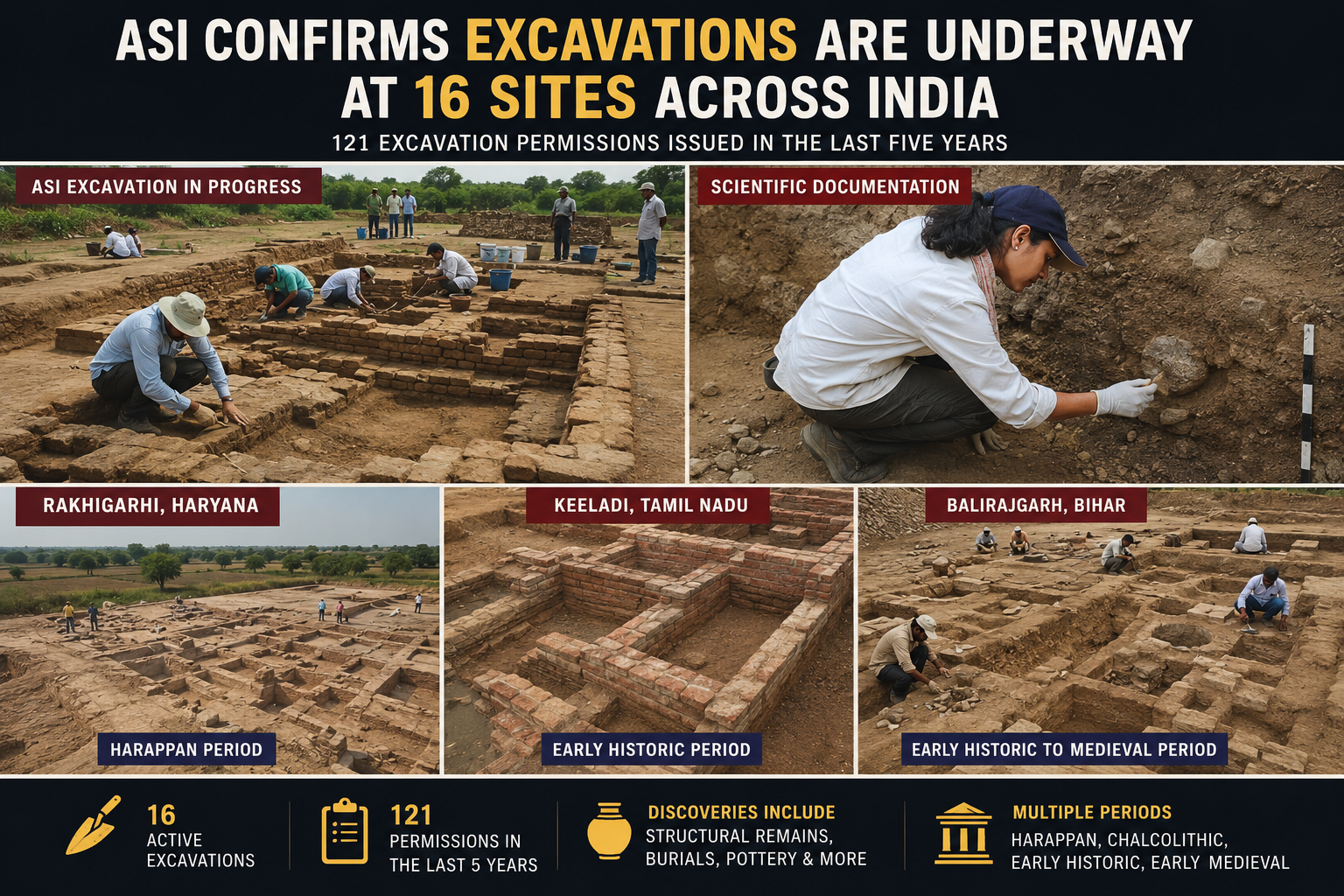
The Archaeological Survey of India (ASI) has confirmed that excavations are currently underway at 16 archaeological sites across India, making this one of the country’s busiest excavation periods in recent years.
The information was officially presented in Parliament by the Ministry of Culture, which also stated that 121 excavation permissions have been granted during the last five years.
This announcement reflects the growing momentum of archaeological research across India and indicates that many important discoveries are likely to emerge in the coming years.
A Nationwide Archaeological Effort
Unlike individual excavation announcements, this update highlights archaeological work taking place across multiple regions of the country.
The active excavations represent diverse cultural periods, landscapes, and research objectives. Archaeologists are investigating prehistoric settlements, ancient cities, temple complexes, burial grounds, and habitation sites.
Each excavation contributes new evidence that helps reconstruct India’s long cultural history.
What Are Archaeologists Discovering?
According to the government’s statement, current excavations are uncovering a wide variety of archaeological remains, including:
- 🧱 Structural remains
- ⚱️ Human burials
- 🏺 Pottery
- 🪨 Stone artefacts
- 🏛️ Architectural remains
- Other archaeological antiquities
Every discovery helps researchers better understand how ancient communities lived, built, traded, and interacted.
Multiple Civilizations Under Investigation
The ongoing excavations span several important periods of Indian history, including:
🏺 Harappan Civilization
Exploring one of the world’s earliest urban civilizations.
⚒️ Chalcolithic Period
Investigating early farming communities that used both stone and copper tools.
🏛️ Early Historic Period
Studying the rise of cities, trade, literacy, and organized settlements.
🛕 Early Medieval Period
Examining temple architecture, regional kingdoms, and evolving religious traditions.
This broad chronological range highlights the diversity of archaeological research currently underway.
Why This Matters
For archaeologists and students, this announcement is significant because excavation is only the beginning of the research process.
Once fieldwork is completed, discoveries undergo:
- Scientific dating
- Laboratory analysis
- Conservation
- Documentation
- Academic publication
Many of the excavations taking place today will likely produce excavation reports, research papers, and new historical interpretations over the next few years.
Indian Archaeology Is Entering an Exciting Phase
The government’s confirmation of 16 active excavations demonstrates that archaeological research in India is expanding across multiple regions and historical periods.
Rather than focusing on a single famous site, archaeologists are building a broader understanding of India’s past—from prehistoric villages to ancient cities and medieval temple landscapes.
The discoveries made during these excavations are expected to shape archaeological research for years to come.
Key Facts
📍 Agency: Archaeological Survey of India (ASI)
⛏️ Active Excavations: 16 archaeological sites
📄 Excavation Permissions (Last 5 Years): 121
🏺 Discoveries Include: Structural remains, burials, pottery, and antiquities
🏛️ Periods Under Study: